Context Gateways
Connect external knowledge and systems with governed context.
Explore gateways →Connect external knowledge and systems with governed context.
Explore gateways →Composable building blocks that power the semantic protocol.
See the units →Every inference is linked to sources, logic, and context.
How it reasons →A collaborative ecosystem building the future of legal intelligence.
Join the society →Protocol
The Mecellem Semantic Protocol is a meaning architecture in which legal knowledge is contextually reconstructed, rendered traceable, and made auditable with each query. It rests upon a coherent hierarchy established among ontological grounding, epistemic justification, and methodological operation — transforming law from a static body of norms into a dynamic and explainable architecture of meaning.
Mecellem transforms al-Farabi's distinction between first and second intelligibles into a contemporary legal knowledge graph architecture. The plane of first intelligibles constitutes the layer of conceptual constants where fundamental legal concepts are defined with ontological precision and their hierarchical relations are determined. The plane of second intelligibles represents the contextual layer where concrete documents, party relations, event elements, and evidence are positioned and interrelated. The semantic layer between these two planes is where meaning is computed in real time and each new query creates a unique semantic path.
The protocol decomposes legal texts into meaning units appropriate to their ontological function. Unlike classical approaches that segment texts solely by technical rules, Mecellem evaluates each document type within its own ontological class. A contract is divided around structural axes such as parties, obligations, breach mechanisms, and termination; whereas an administrative decision is structured in terms of procedure, legal basis, reasoning, and avenues of appeal. The embedding layer then positions these chunks within domain-specific vectorial topology, enabling the same concept to carry different meaning neighborhoods in different legal domains.
The protocol's most distinctive element is that legal meaning is produced not according to a fixed hierarchy, but through a multi-layered weighing system rebalanced in each query. Four knowledge planes exist: legislation, case law, doctrine, and the institutional corpus. Where a clear statutory provision exists, legislation becomes dominant; where interpretative ambiguity exists, case law and doctrine gain weight; in questions of institutional contracts, the institutional corpus becomes determinative. Methodological tools such as knowledge graphs, ontological inference, and vector-based similarity are activated with different weights according to the structural nature of the query.
The protocol rests on three principles. Ontological consistency requires every norm to conform to the order of being it represents. Dynamic meaning flow recognizes that legal meaning is continuously repositioned as new documents, norms, and conditions enter the system. Epistemic verification requires every judgment to pass knowledge-context alignment and temporality tests, ensuring that the normative and institutional corpus grounding any response is both substantively relevant and legally current. The ultimate vision, reflecting al-Farabi's principle that a corrupted order of knowledge corrupts the order of justice, concretizes the chain of accurate knowledge, accurate context, accurate meaning, accurate judgment, and just society.
Mapping, grounding, reasoning, executing. Four disciplines carry a record from raw text to ratified work product — without ever losing the trace.
Mecellem maps the universe of legal meaning: every entity, every relationship, every obligation, every decision.
Every claim Mecellem produces is traced back to its evidence: the clause, the precedent, the regulation, the corporate record. No assertion floats; each one is grounded in a citable source.
Reasoning in Mecellem follows structure. The system does not predict the answer; it constructs the answer from the ground up, showing every step that led to it.
Structured meaning becomes executable work: a memo signed, a risk alerted, a clause revised, a strategy filed, a decision actioned. Mecellem carries meaning all the way to the work product — to the document, the table, the report, the action a human ratifies.
Our Article
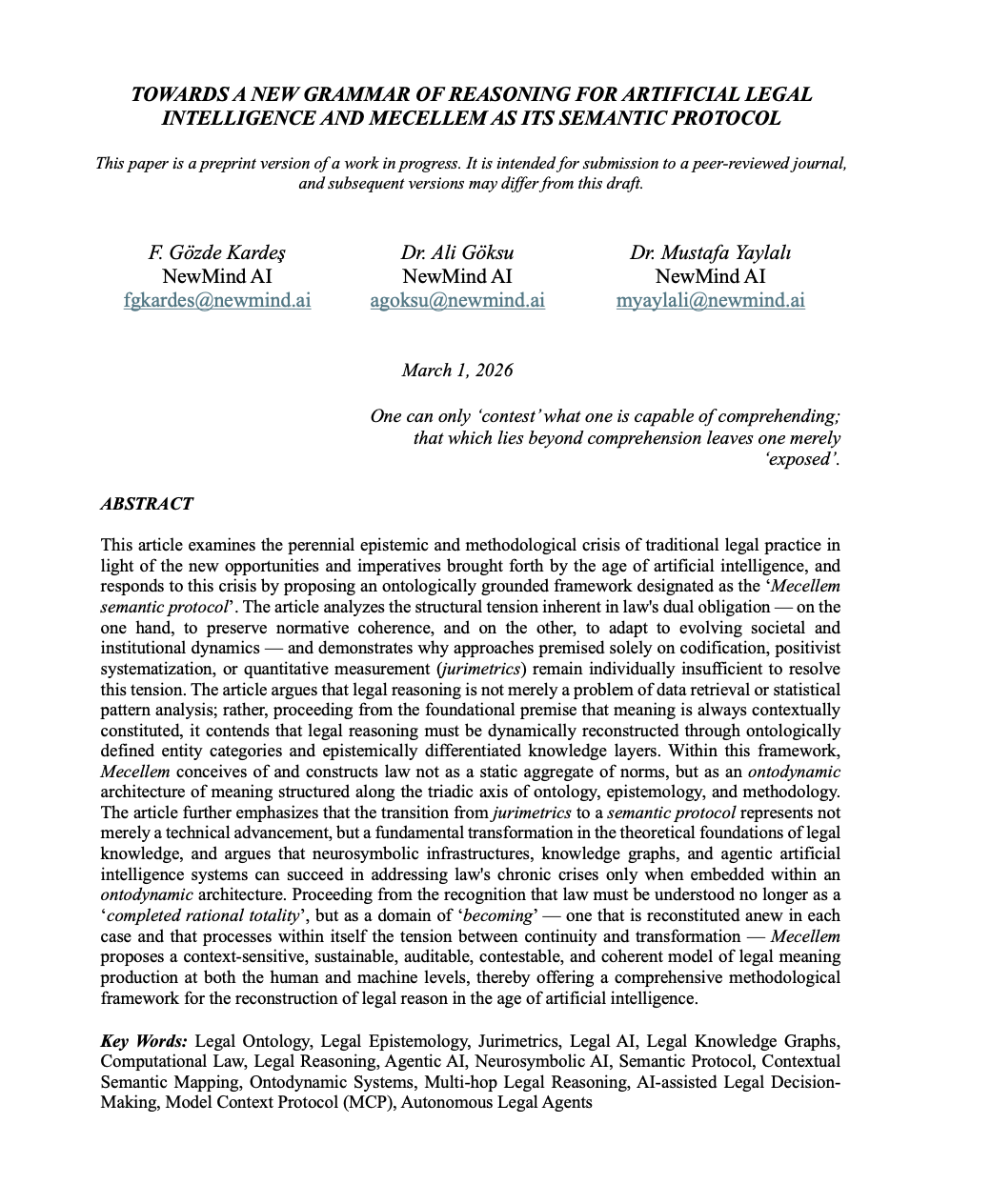
Protocol Paper · 2026
The human desire to know and understand now focuses not just on the accessibility of information but on how it is structured and used. The era we live in is shaped by an unprecedented volume of data and content production. This abundance makes it clear that information cannot be meaningful merely by existing; unless it is conceptualized and enriched with contextual relationships, it loses its capacity to generate meaning.
Every document contains countless entities that can convey meaning to its ultimate stakeholders. However, these entities cannot become effective governance tools unless classified and integrated within context. Established with this awareness, the Mecellem Development Society offers a governance vision that not only stores knowledge but conceptualizes and contextualizes it — transforming content chaos into maps of understanding and complementing static structures with dynamic components.
Mecellem is not just a professional organization; it is an interdisciplinary visionary movement dedicated to rethinking corporate governance. It brings together a wide range of expertise — from legal engineers to software developers, AI specialists to cognitive scientists — aiming to develop dynamic governance systems that combine big data with legal experience, turning raw data into meaningful, connected, and contextual knowledge.
Mecellem restructures the process of accessing and making sense of knowledge through the “content–concept–context” triangle. It analyzes content through a concept-based approach and places it within the broadest contextual framework — a methodology concerned not only with what knowledge is, but with what it transforms into. This methodology is built on Dynamic Knowledge Networks (Mecellem Dynamics) and consists of four layers.
SemanticOS is not search. It is not summarization. It is the discipline that makes legal reasoning contestable, auditable, and reusable.
Meaning needs contexts. The library begins below — three foundational worlds, four operational ones, and thirty-six specialized gateways.
Enter the Context Library →CONTEXT GATEWAYS
Every Context Gateway is a governed window into one domain of legal and corporate meaning. Eight are foundational — four Knowledge and four Operational gateways, ready to deploy today.
What the enterprise must understand.
4 foundational · context gateways
What it must produce, defend, and execute.
4 foundational · context gateways
Connect and create any number of MCP servers — tools, data sources and agents — all governed inside one context layer.
If knowledge is not ordered, intelligence cannot be governed.


